Sunday, October 9, 2011

Summary of a Critical Response


The article I chose was from Knight's Quarterly (Aug - Nov 1824) by an Anonymous author. The author actually was comparing Frankenstein to another book written by Mary Shelley, but was severely disappointed with the book. The author questions if  Frankenstein was even written by Mrs. Shelley, because the writing style were very different. The restrain shown in Valperga is paradoxical to the hyperbole used in Frankenstein. The author goes as far as to claim he reread Frankenstein and analyzed it as if it was supposed to be realistic. The author states that Frankenstein is poorly written and overzealous, whereas Valperga is cautious and a slow read.
The author or critic, read Frankenstein from a harsh unforgiving frame of mind. I felt sorrow for both the Monster and for Victor Frankenstein's childish machinations. Although it is wholly Frankenstein's fault that the Monster is even in existence, I disagree with the author's brash and unforgiving attitude towards Frankenstein. In the name of science all kinds of unnatural occurrences have been brought to fruition.
 "It is utterly inconceivable also that he should have let the monster (as he is somewhat unfairly called) escape" (anonymous, Knight's Quarterly) the author does not allow for any error on the part of Frankenstein to go unnoticed. The Monster commits murder and the author speaks nothing of that, and although I agree that Frankenstein bares the brunt of blame I felt the a Monster or quasi human who could articulate as well as Shelley supposes the Monster could have would know a certain level of right from wrong regardless of how he was treated previously. I agree completely with the author where as the lack of insight in to what Frankenstein was doing make Victor seem more like an impetuous child than an educated man.

After reading this literary analysis of Frankenstein I feel that given the almost two hundred year difference in the time the Author wrote the analysis and the time I read Frankenstein shows a lot in the way we interpret the work. I felt that Victor was doing his work in the name of science and in the hope of a better world for all, and the author felt that Victors ego-centrism was a gateway to a morally repugnant abandonment of his creation.

Another not so well thought out idea   .... Like Frankenstein even modern scientists have created extreme destruction and left a wake of disaster. Myself I think that WAR is a sometimes necessary evil but hand to hand combat is always favorable to me than what was created in 1939 by men who had not realized the full extent of their work.

Sunday, October 2, 2011

Double Vision on Revision....


       When revising a piece of my own writing I find myself often not seeing the grammar mistakes but narrowing in on the content. The questions I am hoping to answer are did I stay on topic? Did I support my thesis? Did I get the reader sidetracked? Does it flow? Then most importantly if I hadn't written this would I like it. Most often I ask another to read and critique my papers, to give an unbiased opinion of my work. If all the questions are answered with a Yes from both myself and the critic then I know I have done a good job and it is worthy of being published. If not, then I know I need to head back to the drawing board and start deconstructing my paper to sort out flaws and amend my thesis. 


      When all else fails, have an English major read it.A great guide to rewriting prose

Sunday, September 25, 2011

Mary Shelley's Frankenstein

Frankenstein tormented like his ancient counterpart Prometheus“A flash of lightning illuminated the object, and discovered its shape plainly to me; it gigantic stature, and the deformity of its aspect, more hideous than belongs to humanity, instantly informed me that it was the wretch, the filthy daemon to whom I had given life.” (Shelley 48)

When Victor Frankenstein is heading back home, after his brother Williams death while in the midst of a lightning storm, he witness his creation climbing over the mountain's near his families estate. Guilt overcomes him that his creation is still alive, and he knows in this moment that his brother's death was caused by his irresponsibility and Godlike quest.He believes (later is proven) that his creation killed his brother William. Later, Victor comes to learn that Justine; his brother's nanny had been framed for the death of William. Victor knew in his heart that his Monster has committed these crimes but he would confess to any, not even to save Justine. As the story goes on, the reader learns from the Monster that he purposefully planted Victors' mother's necklace on Justine to throw suspicion on her.

I chose this passage because the inner struggle Victor has within himself, admitting to himself and to the world that he has been the catalyst of all his families woes, that Victor thought he could wash his hands of his creation. Years of working restlessly in creating, giving little if any thought to what would be the after effects or end product. Victor was driven by the need to defeat death. To play god. When life sprang to his creation he was instantly appalled and afraid of the reality of his creation. He shirks away his duty, like an unwilling father to a unwanted child. The Monster he has created has nothing but animosity to learn from because that is all he has known.

Victor later returns to his home with his friend to find his creation is gone; for awhile he treat the matter didn't existed. He tries to block the Monster out of his conscious, to go on with his own life but is constantly tormented by what he created and the endless thoughts of what could have happened to the byproduct of his malfeasance. Throughout the story even when faced with disaster after disaster Victor never fully accepts his responsibility or his duty to his creation until he has lost all others in his life. Then in the wake of his own failed life he see's it as his duty to chase down his reanimated life form and end it's life as quickly as he had given it. Victor's lack of responsibility would be his curse.

Work Cited
Shelley, Mary. Frankenstein. London: W.W. Norton & Company, Inc., 1818. 48.

Sunday, September 11, 2011

Lady Lazarus

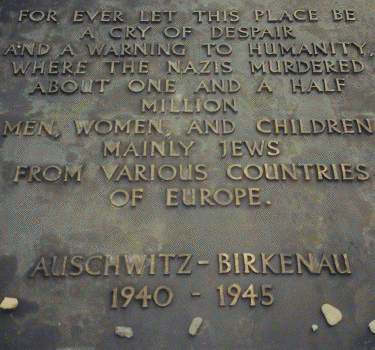
While reading Lady Lazarus by Sylvia Plath, I found myself drawn to the sorrowful tone of the speaker. My initial reaction was that this speaker was a Holocaust survivor or remorseful perpetrator,  but as the poem went on I noticed the reference to Jewish skin on line "A paperweight, My featureless, fine Jew linen" (line 7-9, Plath). The speaker refers to herself as not only of Jewish decent but in a tone that is self-effacing. Later in the poem the speaker becomes almost frantically seeking absolution, taunting the audience with her continued efforts at death. Accidentally near death, an attempted suicide, but never does the speaker speak of her pain or cause for craving death. "So, so Herr Doktor. So, Herr enemy." (Plath) Again, the speaker taunts the audience and we learn that she is speaking to those who would try to deter her death, or stall it. The speaker again makes reference to the Holocaust when she alludes to gold babies, gold teeth being removed. The imagery of train stations at Auschwitz comes to mind and piles of Jewish possessions and valuables fill my subconcious. The helplessness of those at the mercy of Nazi Germany. This speaker must feel it impossible to live as herself but makes reference in the closing stanza of rebirth or rising again to defeat her foes. The tones of the poem change as the speaker changes from desperation of her current state to boasting about her final suppression of those who would keep her from  her goal. The deathly allusion to Nazi's and the Holocaust are a paradoxical theme towards overpowering those "doctors" who are keeping her alive and she wishes to control her own destiny. In all I felt chilled by the analogies made by the writer but see the need to make the poignant declaration of Suicide seem like a reprieve from a life not worth living.

Sunday, August 28, 2011

Introduction


Good Readers and Good Writers


Image Source: http://www.answers.com/topic/vladimir-nabokov-large-image

In Vladimir Nabokov "Good Readers and Good Writers" he describes good readers with few qualities. That good readers pay attention to detail and use their imaginations when they read. That good readers are rereaders and that when we read a book, we should do it with a fresh view. A new view to explore an unknown world that we have never seen before.

I agree with Nabokov that readers should read a book with no expectations or agenda. That your own personal bias can alter what the author is trying to say. That the author's tone should come through first above preconceived notions. In some ways destroying the world or words being put forth on paper.

I do believe that I am a good reader. I always try to keep an open mind when it comes to stories even ones that I'm not particularly fond of. I try to see their point of view as if I was in their shoes, to understand where they were coming from.